
In today’s fast‑paced packaging industry, businesses face a critical choice: pouch packaging machines (VFFS) or flow wrap machines (HFFS). Both technologies are widely used across food, pharmaceuticals, FMCG, and consumer goods. Yet, each machine type serves distinct product categories and business goals.
This blog provides a detailed comparison of pouch packaging machine vs flow wrap machine, backed by industry expertise and practical insights. By the end, you’ll know which technology aligns with your product, throughput, and retail requirements.
What is a Pouch Packaging Machine?
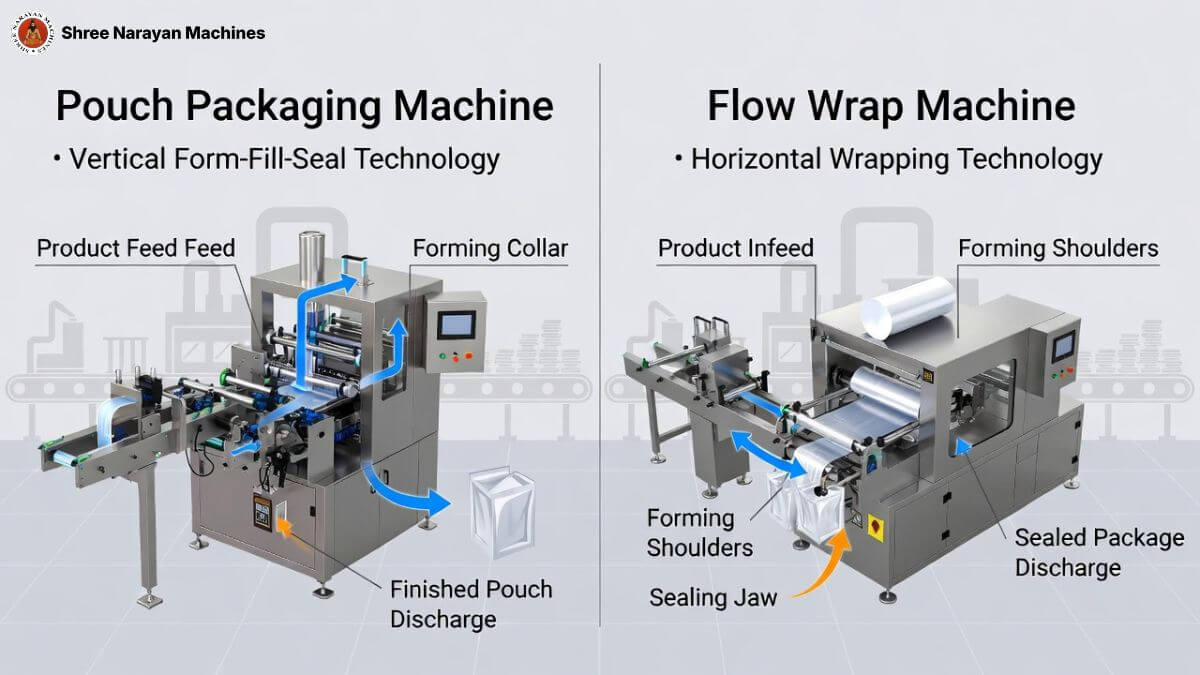
A pouch packaging machine (often vertical form‑fill‑seal, or VFFS) creates pouches from rollstock film, fills them with product, and seals them vertically.
Key Features
- Flexible pouch formats: stand‑up pouches, gusseted bags, zipper pouches, spouted pouches.
- Best for powders, granules, liquids, and snacks.
- High retail appeal: resealable, shelf‑stable, and customizable.
- Barrier films: supports multi‑layer laminates for extended shelf life.
What is a Flow Wrap Machine?
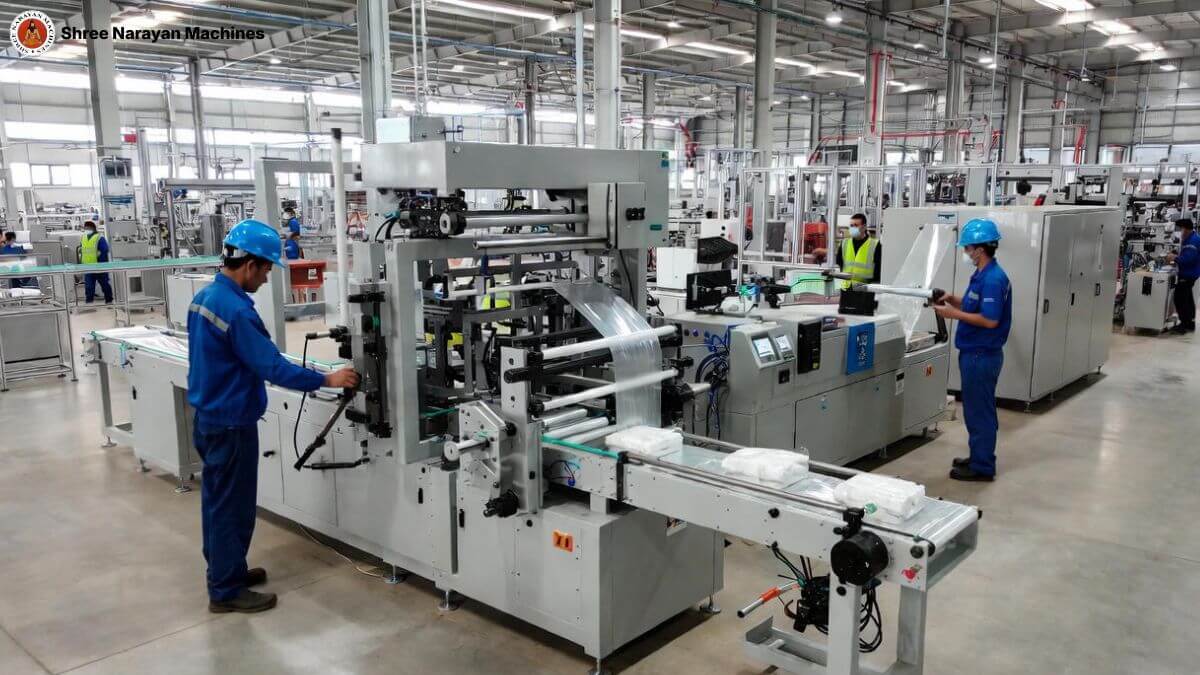
A flow wrap machine (horizontal form‑fill‑seal, or HFFS) wraps products horizontally in a continuous film tube, sealing longitudinally and at both ends.
Key Features
- Package style: pillow packs, fin‑seal, lap‑seal.
- Best for solid, rigid items: chocolate bars, biscuits, bakery goods, medical devices.
- High speed: rotary cutters enable thousands of packs per minute.
- Compact presentation: neat single‑serve packs with hygienic sealing.
Side‑by‑Side Comparison
| Feature | Pouch Packaging Machine (VFFS) | Flow Wrap Machine (HFFS) |
|---|---|---|
| Orientation | Vertical forming, filling, sealing | Horizontal feeding and wrapping |
| Best for | Powders, liquids, snacks, granules | Bars, bakery, medical devices |
| Package formats | Stand‑up pouch, zipper, spout | Pillow pack, fin‑seal, lap‑seal |
| Retail appeal | Strong shelf presence, resealable | Clean single‑serve presentation |
| Throughput | High for bulk pouches | Medium–very high (rotary for speed) |
| Film type | Laminates, barrier films | Laminates, cold‑seal films |
Decision Criteria: Which Machine Should You Choose?
1. Product Form
- Powders/liquids: pouch packaging machine.
- Rigid solids: flow wrap machine.
2. Retail vs Single‑Serve
- Retail shelf presence: pouch packaging machine.
- Single‑serve hygiene: flow wrap machine.
3. Film & Seal Requirements
- Zippers, spouts, resealability: pouch packaging machine.
- Thin laminates, cold‑seal films: flow wrap machine.
4. Throughput Needs
- High‑volume powders/snacks: VFFS.
- High‑speed confectionery/bakery: HFFS rotary flow wrapper.
ROI & Implementation Checklist
ROI Factors to Consider:
- Film cost per pack.
- Changeover time between SKUs.
- Labor savings from automation.
- Scrap rate and seal integrity.
- Spare parts availability and service network.
Implementation Checklist:
- Define product dimensions and pitch.
- Specify film type (laminate, barrier, cold‑seal).
- Confirm certifications (CE, GMP, food‑grade).
- Request vendor trial runs with your product.
- Document OEE (Overall Equipment Effectiveness) before purchase.
Expert Tips for Manufacturers
- Test films in advance: weak seals often stem from film incompatibility.
- Prioritize local service support: downtime costs more than machine price.
- Consider future formats: if you plan to add zippers or spouts, invest in modular pouch machines.
- For confectionery: rotary flow wrappers deliver unmatched speed and efficiency.
FAQs: Pouch Packaging Machine vs Flow Wrap Machine
Que 1. What is the main difference between a pouch packaging machine and a flow wrap machine?
Ans: Pouch packaging machines (VFFS/premade pouch) form or use pouches vertically, fill them, and seal them.
Flow wrap machines (HFFS) wrap products horizontally in a continuous film tube, sealing longitudinally and at both ends.
Que 2. Which products are best suited for pouch packaging machines?
Ans: Powders, granules, liquids, snacks, and products requiring resealable or stand‑up pouches.
Formats include zipper pouches, spouted pouches, and gusseted bags.
Que 3. Which products are ideal for flow wrap machines?
Ans: Solid, rigid items such as chocolate bars, biscuits, bakery goods, medical devices, and single‑serve confectionery.
Formats include pillow packs, fin‑seal, and lap‑seal packs.
Que 4. What are the packaging styles offered by each machine?
Ans: Pouch machines: stand‑up pouch, zipper pouch, spout pouch, gusseted pouch.
Flow wrap machines: pillow pack, fin‑seal, lap‑seal.
Que 5. Which machine offers better retail shelf appeal?
Ans: Pouch packaging machines provide strong shelf presence with resealable and customizable designs.
Flow wrap machines deliver compact, hygienic single‑serve packs with neat presentation.
Que 6. How do throughput speeds compare?
Ans: Pouch machines (VFFS): high speeds for bulk powders and snacks, but slower for complex pouch formats.
Flow wrap machines (HFFS): very high speeds, especially rotary models, often exceeding thousands of packs per minute.
Que 7. Which machine is more cost‑effective in terms of film usage?
Ans: Flow wrap machines generally use less film per pack due to compact pillow or fin‑seal designs.
Pouch machines may consume more film but offer added value through resealability and shelf appeal.
Que 8. Can both machines handle biodegradable or recyclable films?
Ans: Yes, but compatibility depends on sealing technology:
Pouch machines: must match film barrier properties and sealing temperature.
Flow wrap machines: cold‑seal or heat‑seal jaws must be tuned to film type.
Que 9. Which industries commonly use pouch packaging machines?
Ans: Food & beverage (snacks, powders, liquids), pharmaceuticals, nutraceuticals, and household products.
Que 10. Which industries rely on flow wrap machines?
Ans: Confectionery, bakery, medical devices, personal care, and fast‑moving consumer goods (FMCG).
Que 11. What are the maintenance requirements?
Ans: Pouch machines: regular checks on filling systems, sealing jaws, and film feed.
Flow wrap machines: cutter synchronization, film tension, and seal jaw calibration.
Que 12. How do I decide which machine is right for my business?
Ans: Evaluate:
Product form (powder/liquid vs solid).
Target throughput (packs/min).
Retail requirements (resealable vs single‑serve).
Film type and seal integrity.
Also Read: Future of Packaging Machines in India 2026– Smart, Sustainable & Automated
Conclusion
Both pouch packaging machines and flow wrap machines are indispensable in modern packaging. The right choice depends on product form, retail requirements, and throughput goals.
- Choose pouch packaging machines (VFFS) for powders, liquids, snacks, and resealable retail packs.
- Choose flow wrap machines (HFFS) for bars, bakery, medical devices, and single‑serve packs.
👉 Next step: Audit your product line, define throughput targets, and run vendor trials. This ensures you invest in the right machine that maximizes ROI and strengthens your brand presence.