
Investing in a Flow Wrap Machine is a strategic decision for manufacturers in food, pharmaceuticals, and consumer goods. While the upfront capital expenditure may seem significant, the long‑term benefits in efficiency, hygiene, and product presentation often outweigh the costs. To make an informed decision, businesses must calculate the Return on Investment (ROI) of a flow wrap machine with precision.
Why ROI Matters in Packaging Machinery
ROI is not just a financial metric—it’s a measure of how effectively your packaging line supports business growth. A well‑calculated ROI helps manufacturers:
- Justify capital expenditure to stakeholders.
- Compare different flow wrap machine models.
- Forecast payback periods and long‑term savings.
- Align packaging investments with production goals.
Key Factors in Flow Wrap Machine ROI Calculation
1. Capital Expenditure (CAPEX)
- Machine purchase price.
- Installation and integration costs (10–30% of machine price).
- Facility modifications, training, and spare parts.
2. Operational Savings
- Labor reduction: Flow wrap machines often cut operator needs by 40–60%. For example, reducing from 5 workers to 2 can save ₹12–15 lakh annually.
- Film efficiency: Servo‑controlled tension reduces film waste by 5–10%.
- Downtime reduction: Preventive maintenance avoids costly stoppages (₹4,000–₹8,000 per hour in losses).
3. Productivity Gains
- Speeds of 40–250 packs per minute.
- Consistent sealing reduces rework and rejects.
- Ability to handle multiple product sizes and films increases flexibility.
4. Revenue Impact
- Improved shelf presentation enhances brand perception.
- Extended shelf life through hygienic sealing and optional nitrogen flushing.
- Compliance with food and pharma standards reduces risk of recalls.
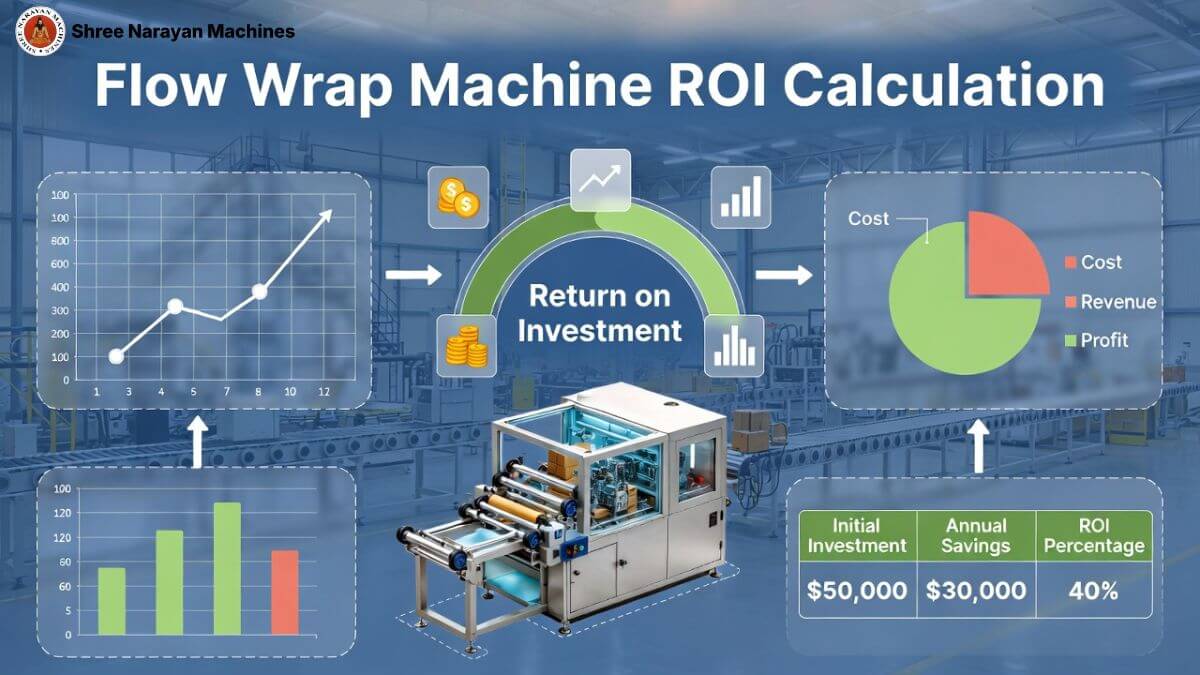
Step‑by‑Step ROI Calculation
- Identify total investment (CAPEX): Machine + installation + training.
- Estimate annual savings: Labor, film, reduced downtime.
- Calculate payback period: CAPEX ÷ annual savings.
- Example: ₹25 lakh investment ÷ ₹12 lakh annual savings = ~2 years payback.
- Project long‑term ROI: Consider 5–10 year lifecycle, factoring in preventive maintenance (3–5% of CAPEX annually).
Risks and Considerations
- Underestimating integration costs can delay ROI.
- Ignoring preventive maintenance may extend payback periods.
- Mismatch in machine capacity vs. demand can reduce efficiency.
Also Read: How to Calculate Flow Time of Cutter in Flow Wrap?
Conclusion
A Flow Wrap Machine ROI calculation is more than a spreadsheet exercise—it’s a strategic evaluation of how automation transforms your packaging line. By considering CAPEX, operational savings, productivity gains, and revenue impact, businesses can confidently invest in flow wrap machines that deliver measurable returns.